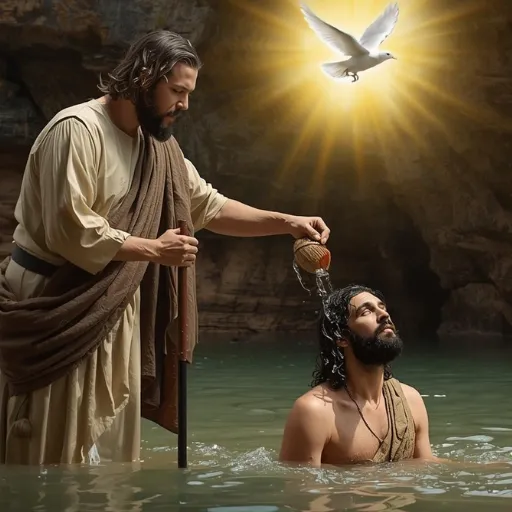
Year A: The Baptism of the Lord
Scripture: Matthew 3:13-17
OPENING
My brothers and sisters, have you ever experienced a moment when someone you love looked at you and said, "I'm proud of you"? Perhaps it was a parent at your graduation, a spouse after a difficult sacrifice, a mentor after years of struggle. Do you remember how those words landed on you? How they seemed to reach past all your failures and fears, past even your accomplishments, and touch something more profound—your very identity, your belovedness?
Now imagine hearing those words not after you've achieved something, but before you've begun. Not as a reward, but as a foundation. Not as a conclusion, but as a commissioning.
This is what happens in today's Gospel. Jesus stands in the Jordan River, and before He preaches a single sermon, before He works a single miracle, before He hangs on any cross, the heavens tear open, and the Father speaks: "This is my beloved Son, with whom I am well pleased." Identity precedes activity. Belovedness precedes accomplishment.
And here's what's extraordinary: Jesus goes into those waters not to be cleansed—He who is without sin—but to stand in solidarity with us, to sanctify the very waters that will become our gateway into this same identity. His baptism is the door through which our baptisms will have meaning.
ILLUMINATION
Let's be clear about what's happening here. John the Baptist is reluctant. Matthew tells us John tried to prevent Jesus: "I need to be baptized by you, and yet you are coming to me?" John knows this is backwards. His baptism is a baptism of repentance, and Jesus has nothing to repent. But Jesus insists: "Allow it now, for thus it is fitting for us to fulfill all righteousness."
What does this mean? Jesus is entering into the complete human condition—not its sinfulness, but its brokenness, its need, its longing for redemption. As Isaiah prophesied in our first reading, "Here is my servant whom I uphold, my chosen one with whom I am pleased." The Servant comes not to stand above the people but among them, not to condemn the bruised reed but to bind it up.
The early Church Father, St. John Chrysostom, preached that when Jesus descends into the Jordan, He sanctifies all waters for all future baptisms. The Creator enters creation. The Light falls into the depths. And what rises from those waters is not just a wet rabbi from Nazareth, but the inauguration of a new creation.
Notice what happens next: "The heavens were opened." This is the language of rupture, of divine invasion. Since the Fall, heaven and earth had been separated. But now the separation is torn—not gently parted but opened—and the Spirit descends like a dove.
Why a dove? Because at creation, the Spirit hovered over the waters of chaos and brought forth life. Now, at this new creation, the Spirit hovers over these waters and brings forth new life. Every baptism since has been an echo of this moment—the Spirit hovering, heaven opening, identity bestowed.
And then the voice: "This is my beloved Son." The Greek word here is agapētos—not just loved, but beloved, cherished, the object of the Father's infinite delight. And this is spoken before Jesus does anything. It is gift, not wage. Identity, not achievement.
St. Thomas Aquinas teaches us that Christ's baptism manifests the entire Trinity: the Father's voice, the Son's presence, the Spirit's descent. Every Christian baptism makes us partakers in this Trinitarian life. We're not just joining a club or making a commitment—we're being incorporated into the very life of God.
PASTORAL APPLICATION
So what does this mean for us, here, today?
First, it means that your identity is not built on what you accomplish, but on whose you are. You are God's beloved. Full stop. Not when you're holier, not when you've conquered that sin, not when you've finally gotten your life together. Now. Today. In your brokenness and your beauty, in your doubt and your desire—you are claimed by the Father who spoke over those waters.
I know the inner voices many of you carry. The parent who never said they were proud. The spouse whose love feels conditional. The internalized critic that says you're only as good as your last success, your last act of virtue, your last moment of clarity. Today's Gospel speaks directly to those voices: they are liars.
Your baptism—whether you remember it or not—was the moment heaven opened over your life. The Spirit descended. The Father spoke your name. And that word can never be unspoken. That seal can never be broken. You may forget it, ignore it, run from it—but God does not have amnesia about His children.
But here's the second thing: this identity carries a mission. Notice that immediately after His baptism, Jesus is driven into the desert to be tempted, and then He begins His public ministry. Belovedness is not an excuse for passivity. It's the only foundation strong enough for the mission God gives each of us.
You don't earn God's love by serving the poor, by forgiving your enemy, by standing up for truth in your workplace, by being patient with your difficult teenager, by remaining faithful in your struggling marriage. You do these things because you are already loved. You act from fullness, not for it. From security, not for it.
This is why the moral life isn't primarily about behavior modification. It's about becoming who you already are. You are a beloved child of God who was baptized into Christ's death and resurrection. Now live like it. Not to become beloved, but because you are.
And third: just as Jesus entered the waters of solidarity with sinners, we are called to that same descent. Christian faith is not a balloon that lifts us above the messiness of human life. It's a baptism that plunges us into it—into the suffering of our neighbor, into the confusion of the culture, into the broken places where Christ is most present because the need is greatest.
Who are the people you'd rather not stand beside in the waters? The political opponent, the family member who hurt you, the person whose lifestyle you find troubling, the refugee, the addict, the person whose poverty makes you uncomfortable. Jesus stood in the Jordan with prostitutes and tax collectors, not because He approved of everything they did, but because He loved who they were. And He invites us into the same risky, costly solidarity.
CLOSING INVITATION
My friends, in a few moments we will participate in the Eucharist, and at every Mass we are invited to remember our baptism. Before we approach this altar, I want you to do something. Close your eyes for just a moment. Picture those waters. Picture the heavens opening. Picture the Father looking at you—yes, you—with infinite pleasure and saying, "This is my beloved child."
Let that word sink beneath your accomplishments and your failures, beneath your masks and your fears, all the way down to that place where your truest self-lives.
This week, I invite you to one concrete practice: Each morning when you wake, before you check your phone, before you rehearse your anxieties, make the Sign of the Cross on your forehead—the same cross traced there at your baptism—and say these words: "I am beloved by the Father, redeemed by the Son, sealed by the Holy Spirit." Let that be your foundation.
And then, from that belovedness, ask the Lord: "Who are you calling me to stand beside today? Where are the waters you're asking me to enter?" It might be a conversation you've been avoiding. An act of service that scares you. A forgiveness you've been withholding. A truth you need to speak.
As we now enter into this great mystery of the Eucharist, let us remember: the same Jesus who entered the Jordan enters into bread and wine, descends into these humble elements to meet us, to feed us, to remind us once again that we are His beloved. Heaven opens here. The Spirit descends here. The Father speaks here.
Thanks be to God.
