Year A: 2nd Sunday in Ordinary Time
Scripture: John 1:29-34
Homily for the Second Sunday in Ordinary Time
OPENING
My brothers and sisters, have you ever had someone vouch for you? Perhaps you needed a job reference, a cosigner for a loan, or a character witness in a difficult situation. There's something powerful—and humbling—about having another person stake their reputation on yours, to say publicly, "I know this person. I can testify to who they are."
Last week, many of us made resolutions for this new year. Perhaps we resolved to pray more consistently, to be more patient with our families, to be more generous. But if we're honest, we know that our own willpower, our own determination, isn't quite enough. We need something—Someone—beyond ourselves.
This is precisely where our readings meet us today. We hear John the Baptist doing something remarkable: he's pointing away from himself to Jesus, testifying to something he witnessed, vouching for the Lamb of God. And in doing so, he shows us how God's plan unfolds—not through our own credentials, but through God's choice, God's anointing, God's power.
ILLUMINATION
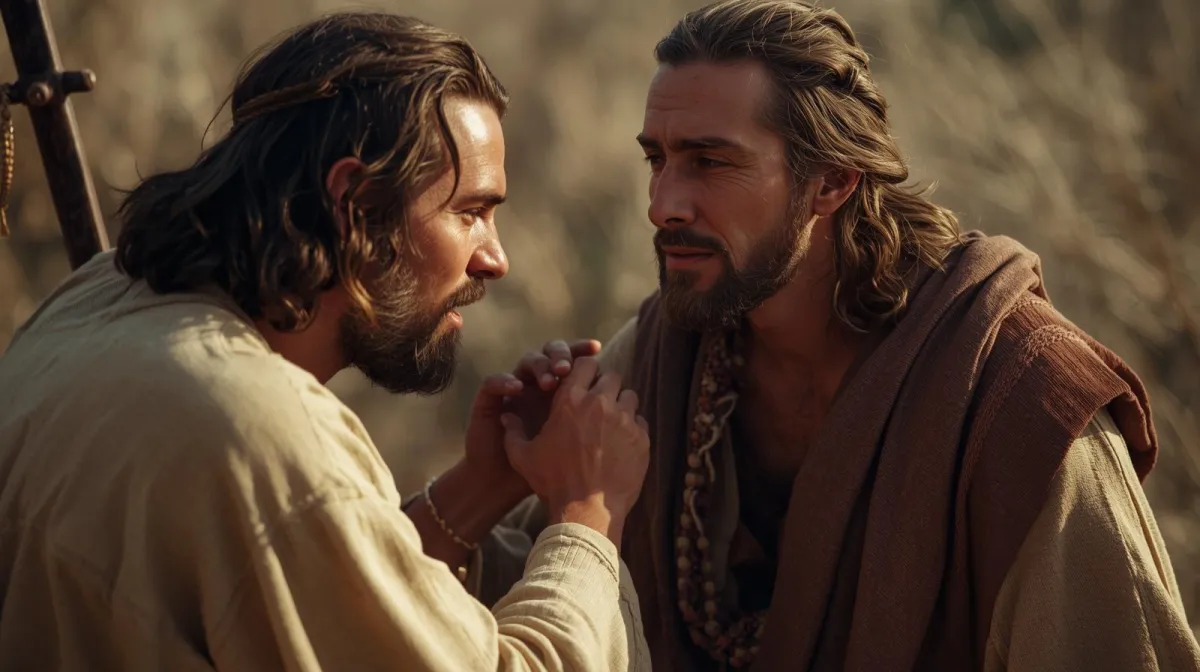
In our Gospel, John the Baptist gives us one of the most profound testimonies in all of Scripture. Twice he says, "I saw and I testified." But notice what he saw: "I saw the Spirit come down like a dove from heaven and remain upon him."
That word "remain" is crucial. In John's Gospel, the Greek word menō—to remain, to abide, to dwell—appears again and again. The Spirit doesn't just visit Jesus momentarily; the Spirit remains upon Him. This is the fulfillment of Isaiah's prophecy about the Messiah: "The Spirit of the Lord shall rest upon him." Unlike the prophets of old, who experienced the Spirit coming upon them for specific tasks, Jesus possesses the fullness of the Spirit permanently. He is the one who will baptize not merely with water, but "with the Holy Spirit."
John himself admits something startling: "I did not know him." Even though John and Jesus were cousins, even though John had been preparing the way, he needed God to reveal who Jesus truly was. God told John, "On whomever you see the Spirit come down and remain, he is the one who will baptize with the Holy Spirit." John's testimony isn't based on family connection or human wisdom—it's based on divine revelation.
This connects beautifully with our first reading from Isaiah. God says through the prophet: "I will make you a light to the nations, that my salvation may reach to the ends of the earth." Jesus is that light, but notice: He's not just the Savior of one people, one nation. His mission is universal. When John calls Him "the Lamb of God, who takes away the sin of the world," that word "world" echoes Isaiah's vision. Not just our sins, not just Israel's sins—the world's sin.
And Saint Paul, in our second reading, addresses the Corinthians as "you who have been sanctified in Christ Jesus, called to be holy." Paul reminds us that holiness isn't something we manufacture; it's a call, a gift, bestowed through Christ. We are sanctified—made holy—in Christ Jesus, not apart from Him.
The Church Fathers loved to meditate on why Jesus, who had no sin, submitted to John's baptism. Saint Gregory of Nazianzus teaches us that Christ descended into the waters to sanctify baptism itself, to transform it from a symbolic washing into a sacramental rebirth. As the Second Vatican Council reminds us in Lumen Gentium, we are made sharers in Christ's own mission as priest, prophet, and king through our baptism. What John witnessed at the Jordan—the Spirit descending and remaining—becomes our reality in the baptismal font.
PASTORAL APPLICATION
So what does this mean for us, here, today?
First, it reminds us that our Christian life is never about our resume or our accomplishments. John didn't know Jesus through human means; he knew Him through revelation. The Spirit revealed Christ to John, and the Spirit reveals Christ to us—in Scripture, in the sacraments, in prayer, in the poor, in one another. We might be tempted to think our faith depends on our intelligence, our spiritual achievements, our moral performance. But today's readings remind us: it's about receptivity to the Holy Spirit.
How often do we ask the Holy Spirit to show us Jesus more clearly? In our daily prayer, do we move beyond our shopping lists of requests to simply ask, "Open my eyes. Let me see Christ more deeply"? This isn't pious sentimentality; it's what John models for us—a radical openness to divine revelation.
Second, notice John's response once he sees: he testifies. He doesn't keep this knowledge to himself. He points. He proclaims. "Behold, the Lamb of God!" His entire mission is to decrease so that Christ might increase.
We live in a culture obsessed with building personal brands, with being seen and recognized. But John shows us a different way: the way of witness. Our baptism makes us prophets—not because we're perfect, but because we've encountered Christ and we can't keep silent about Him. This doesn't mean we all need to become street preachers, but it does mean our lives should point beyond ourselves.
Who in your life needs to hear about Jesus? Perhaps it's a child or grandchild drifting from the faith. Perhaps it's a coworker who's curious about why you have hope. Perhaps it's a friend going through suffering. Like John, we may feel inadequate—"I didn't even know Him myself!" But that's precisely the point. Our testimony isn't about our holiness; it's about His.
Third, we're reminded that Christ baptizes with the Holy Spirit. At our own baptism, we received the Holy Spirit. At Confirmation, that same Spirit was strengthened in us for mission. But do we live as though we've been baptized in the Spirit? Or do we live as functional deists, believing God exists but acting as though we're on our own?
The Spirit who descended and remained on Jesus wants to remain in us. Jesus Himself promises this in John's Gospel: "If you love me, you will keep my commandments. And I will ask the Father, and he will give you another Advocate to be with you always." The question is: are we cooperating with that indwelling presence? Or are we so filled with noise, with distraction, with worry, that we've crowded out the Spirit's gentle voice?
CLOSING INVITATION
My brothers and sisters, in a few moments, we'll renew our participation in the greatest testimony of all: the Eucharist. Here, Christ makes present His sacrifice as the Lamb of God who takes away our sins. John pointed to Jesus and said, "Behold!" And we echo those words at every Mass: "Behold the Lamb of God, behold Him who takes away the sins of the world."
This week, I invite you to do two things. First, each day, ask the Holy Spirit to reveal Jesus to you more clearly—in your prayer, in the people you meet, in the circumstances of your life. Pray simply: "Come, Holy Spirit, open my eyes."
Second, look for one opportunity to be like John the Baptist—to point someone toward Christ. Not through preaching at them, but through authentic witness: through patient love, through humble service, through a word of hope, through the way you face suffering or celebrate joy.
Let us now prepare our hearts to receive the Lamb of God, who alone can satisfy our deepest hunger, who alone can give us the life we were created for.
