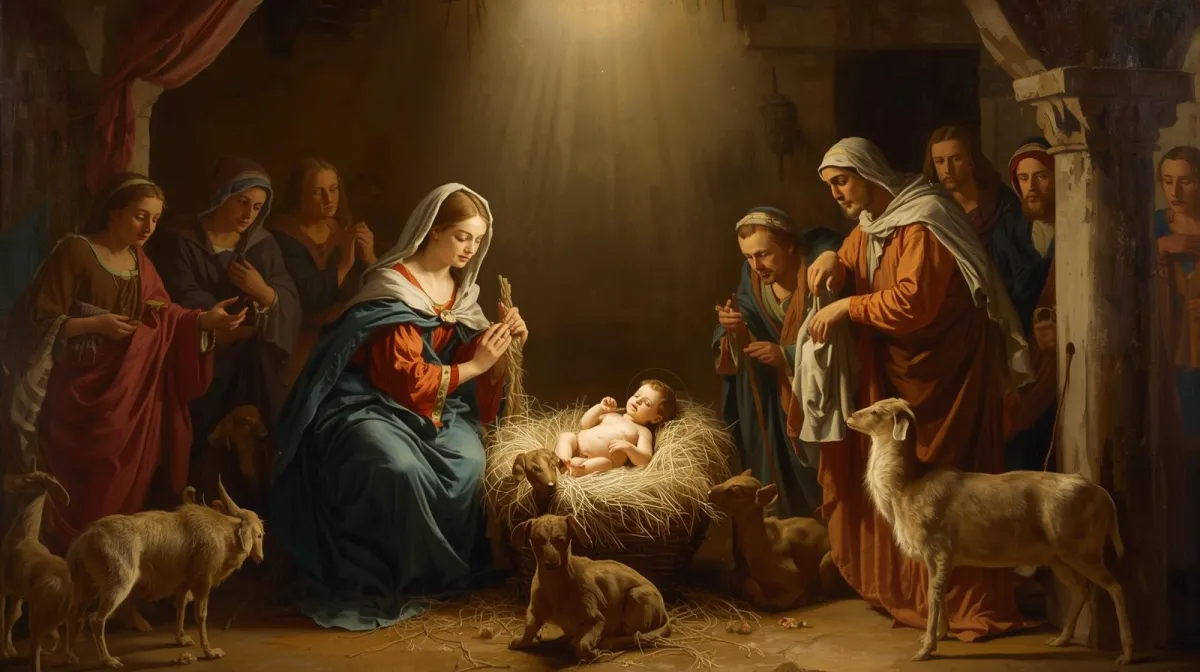
The Word Made Flesh: God's Ultimate Self-Revelation
My dear brothers and sisters in Christ,
Grace and peace to you in the name of our Lord Jesus Christ, the Word made flesh, who dwells among us full of grace and truth.
Today, we turn our hearts and minds to one of the most profound and beautiful passages in all of Sacred Scripture—the Prologue to the Gospel of John. These fourteen verses constitute what many theologians consider the summit of New Testament Christology. This soaring hymn takes us from eternity into time, from the heights of divine mystery into the depths of human flesh, from the cosmic vastness of creation to the intimate dwelling of God among His people.
As we meditate together on these sacred words, I invite you to open your hearts not merely to intellectual understanding, but to transformative encounter. For this text is not simply information about Christ—it is an invitation into communion with Him. It is a doorway into the very heart of God's eternal love for humanity.
In the Beginning Was the Word
"In the beginning was the Word, and the Word was with God, and the Word was God. He was in the beginning with God."
Listen to how John begins. Not "Once upon a time," not "In the days of King Herod," but "In the beginning"—en archē. These exact words open the Book of Genesis, and John chooses them deliberately. He is telling us that to understand Jesus Christ, we must go back before Bethlehem, before Jerusalem, before Abraham, before Adam—back to the very beginning, to the eternal now where God exists outside of time.
But John goes further than Genesis. Where Genesis says, "In the beginning, God created," John says, "In the beginning was the Word." The verb tense matters enormously here. Not "came to be," not "was created," but "was"—continuous, eternal existence. Before all things, the Word already was. The Word has no beginning because the Word is God.
Who is this Word? The Greek term is Logos—a word rich with meaning in both Jewish and Greek thought. To the Greek philosophical mind, the Logos was the rational principle that ordered the cosmos, the divine reason that gave structure and meaning to reality. To the Hebrew mind, shaped by the Scriptures, the Word of God was the powerful, creative utterance by which all things came into being. "God said, 'Let there be light,' and there was light." The Word of God in the Old Testament is active, effective, accomplishing what it speaks.
John synthesizes both traditions and transcends them. The Logos is not an impersonal force or philosophical abstraction. The Word is personal, relational—the Word was "with God," in communion with God, face-to-face with God. And yet, simultaneously, the Word "was God"—sharing fully in the divine nature, possessing the fullness of deity.
Here we encounter the great mystery of the Trinity, not yet fully articulated but already proclaimed. The Word is distinct from God—with God—and yet is God. Two realities held in perfect tension: distinction and unity, relationship and oneness. This is the heartbeat of Christian faith: God is not a lonely monad but an eternal communion of love, Father, Son, and Holy Spirit, forever giving and receiving, forever united in the bond of perfect love.
My dear friends, why does this matter? Because it tells us that relationship, communion, love—these are not accidents of creation, not merely human experiences. They are written into the very fabric of divine reality. God is love, not as a feeling or sentiment, but as the eternal exchange of self-giving that constitutes the Trinity. And we are made in the image of this God, called to reflect this communion in our own lives.
The Word as Creator and Life
"All things came into being through him, and without him not one thing came into being. What has come into being in him was life, and the life was the light of all people."
John now reveals the cosmic significance of the Word. The same Word who was with God in the beginning is the agent of creation. Everything that exists came into being through Him. Not "by Him" as a mere instrument, but "through Him" as the mediating presence through which the Father's creative will is accomplished.
This teaching echoes the Wisdom literature of the Old Testament, where Wisdom is personified as being present with God at creation, the master craftsman through whom all things were made. The early Church recognized in Christ the fulfillment of these Wisdom texts. Christ is the Wisdom of God, the blueprint and pattern according to which all creation is fashioned.
Think of what this means: every atom, every star, every living creature, every human person—all exist through Christ. The Word is the source and sustainer of all reality. As the Letter to the Colossians tells us, "In him all things hold together." The universe is not a cosmic accident but a divine utterance, spoken into being by the Word, sustained moment by moment by His power.
And "in him was life." Not merely biological existence, but zoē—the abundant, eternal life that is the very life of God Himself. This life is not just one attribute among many; it is the defining characteristic of the Word. He is the fountain of life, the source from which all living things draw their being.
This life, John tells us, "was the light of all people." Here we see the fusion of two great metaphors: life and light. Where there is life, there is light. Where there is light, there is the possibility of sight, of understanding, of truth. The Word who is life becomes the light that illuminates the human condition, revealing truth, exposing falsehood, guiding us out of darkness and into the path of righteousness.
But notice—this light shines for "all people." Not just for Israel, not just for the chosen people, but for every human being. There is a universal dimension to the Word's illumination. Every person who has ever lived has been touched by this light, however dimly perceived. This is what Catholic tradition has called the "seeds of the Word" scattered throughout human history and culture. Wherever truth is sought, wherever beauty is celebrated, wherever goodness is pursued—there the light of the Word is shining.
The Conflict Between Light and Darkness
"The light shines in the darkness, and the darkness did not overcome it."
But here we encounter a sobering reality: the presence of darkness. John is a realist. He knows that our world is not simply bathed in light. There are shadows, obscurities, evil forces that resist and oppose the light.
The verb John uses here is fascinating and ambiguous. The darkness "did not overcome" the light—but the Greek word can also mean "did not comprehend" or "did not grasp." Both meanings are true. The darkness neither understands the light nor can it extinguish it. Evil is ultimately blind; it cannot perceive the truth and beauty of the good. And evil, for all its terrible power, cannot overcome the light of Christ.
This is a message of profound hope, dear friends. We live in times of great darkness—violence, injustice, hatred, division. We see it in our world, in our communities, sometimes even in our own hearts. But the testimony of John is clear: the light keeps shining, and the darkness cannot extinguish it. The light that has been shining since before creation, the light that illuminates every person, the light that became flesh in Jesus Christ—this light is inextinguishable.
Evil has no creative power. It can only corrupt, destroy, distort what good has made. Darkness is the absence of light, not a competing force of equal power. And so, the smallest candle can pierce the deepest darkness. A single act of love can transform a situation of hate. One truth-teller can expose a web of lies. This is our hope and our calling—to be light-bearers in a dark world, knowing that the Light of the World fights alongside us.
The Witness of John the Baptist
"There was a man sent from God, whose name was John. He came as a witness to testify to the light, so that all might believe through him. He himself was not the light, but he came to testify to the light."
John the Evangelist now introduces John the Baptist, and he's careful to clarify the Baptist's role. John was "sent from God"—a prophet with a divine mission. But John was not himself the light; he was a witness to the light.
This distinction is crucial. The Baptist's greatness consisted not in drawing attention to himself but in pointing beyond himself to Christ. "He must increase, I must decrease," John the Baptist would later say. This is the model of all Christian discipleship. We are not called to be the light but to bear witness to the light. We are not the Savior but servants of the Savior, moon to His sun, reflecting His glory to a darkened world.
And notice the purpose: "so that all might believe through him." Witness exists for the sake of faith. John testified so that others might come to believe in Christ. Every Christian shares this same vocation. We are all witnesses, called to testify by our words and our lives to the reality of Christ. Our testimony is not about our own spiritual accomplishments or moral superiority—it is always and only about Him, about what He has done, about who He is.
The True Light Enlightens Everyone
"The true light, which enlightens everyone, was coming into the world. He was in the world, and the world came into being through him; yet the world did not know him."
Here John makes an astonishing claim: the true light "enlightens everyone." Every person, without exception, receives some measure of illumination from Christ. This is the basis for the natural law written on human hearts, the universal moral sense, the hunger for truth that characterizes humanity across all cultures.
But then comes the tragic irony: "He was in the world, and the world came into being through him, yet the world did not know him." The Creator came to His creation, and creation failed to recognize Him. The Word through whom all things were made spoke in human language, walked on the earth He fashioned, and humanity looked right past Him.
This is the mystery of sin—not merely moral failure, but blindness, deafness, hardness of heart. Sin distorts our perception so that we cannot see what is plainly before us. We become like people who have lived so long in darkness that when the light comes, it hurts our eyes, and we turn away.
But there's another dimension to the word "world" here. In John's Gospel, "world" (kosmos) has multiple meanings. It can mean the created order, which is good. It can mean humanity, which God loves. But it can also mean the system of values and powers organized in opposition to God. The world in this sense is what we might call the "worldly world"—the realm of pride, greed, violence, and self-sufficiency that rejects God's sovereignty.
This world—the world as a system of rebellion against God—did not and cannot know Christ. Those who are invested in darkness flee from the light, not because the light is harsh, but because it exposes their deeds.
The Rejection and Reception
"He came to what was his own, and his own people did not accept him. But to all who received him, who believed in his name, he gave power to become children of God."
The sorrow deepens. The Word came not just to the world generally but to "his own"—specifically, to Israel, the people chosen and formed by God, the people of the covenant. And His own people, by and large, did not accept Him. This is the pain of rejected love, the ache of unrequited devotion. God had prepared Israel for centuries to recognize the Messiah, and when He came, they did not receive Him.
But this is not the end of the story. While many rejected Him, some received Him. To these—"to all who received him, who believed in his name"—He gave an extraordinary gift: the power to become children of God.
Think of what this means, beloved. It is not merely that we are God's creatures, not merely that we are made in His image. Through faith in Christ, through receiving the Word made flesh, we are given the power—the authority, the right, the capacity—to become God's children. This is adoption into the divine family, entrance into the very life of the Trinity.
This is not something we achieve by our own efforts. It is a gift, a power given to us. But notice the conditions: receiving and believing. Receiving Christ means welcoming Him, making room for Him, accepting Him into the center of our lives. Believing in His name means trusting in who He is and what He has done, staking our lives on His trustworthiness.
Born of God
"Who were born, not of blood or of the will of the flesh or of the will of man, but of God."
John clarifies that this new birth, this becoming children of God, is of a completely different order than natural birth. It is not from "blood"—not a matter of genetic inheritance or ethnic identity. It is not from "the will of the flesh"—not produced by human desire or passion. It is not from "the will of man"—not achieved by human decision or effort.
This birth is from God alone. It is divine initiative, supernatural regeneration, the work of the Holy Spirit creating new life where death reigned. This is what Jesus will later call being "born again" or "born from above" in His conversation with Nicodemus.
This is humbling and liberating at once. We cannot manufacture our own salvation. We cannot earn our way into God's family. No pedigree, no moral achievement, no human willpower can accomplish what only God can do. But God offers it freely to all who will receive it.
This also means that the family of God transcends all human divisions. In Christ, there is neither Jew nor Greek, slave nor free, male nor female. The Church is a family not of blood but of water and Spirit, not of human willing but of divine grace. We are siblings not because of shared ancestry but because of shared adoption by the one Father through the one Son in the one Spirit.
The Word Became Flesh
"And the Word became flesh and lived among us."
Here we arrive at the beating heart of the Prologue, the axis on which all salvation history turns. The eternal Word, through whom all things were made, who was with God and was God from the beginning—this Word "became flesh."
Became. Not "appeared to be flesh," not "took on the appearance of flesh," but truly, actually became flesh. The verb is egeneto—it happened, it came to pass. The Incarnation is a real event in history, not a myth or metaphor.
And the word "flesh"—sarx—is the most earthy, material, vulnerable term John could have chosen. Not "body" in the philosophical sense, but flesh—with all its frailty, mortality, neediness. The Word entered fully into the human condition, accepting all its limitations (except sin). He who is infinite became finite. He who is eternal entered time. He who is spirit took on matter. He who is impassible became capable of suffering and death.
This is the scandal and glory of Christianity. God did not remain at a safe distance from human suffering. He did not send a message from afar or dispatch an angel to explain things. He came Himself. The infinite became an infant. The all-powerful became weak. The immortal became mortal. This is love beyond comprehension—God's willingness to enter into our condition to save us from within.
"And lived among us"—literally, "pitched his tent among us" or "tabernacled among us." This is the language of the Exodus, when God dwelt among His people in the tabernacle, the tent of meeting. Now the ultimate tabernacle is not a structure but a person. The glory that once filled the temple now dwells in human flesh. Jesus is the new temple, the meeting place between God and humanity, Emmanuel—God with us.
We Have Seen His Glory
"And we have seen his glory, the glory as of a father's only son, full of grace and truth."
John testifies as an eyewitness. "We have seen"—not in vision or imagination, but with physical eyes. The invisible God has become visible. The intangible has become tangible. "That which was from the beginning, which we have heard, which we have seen with our eyes, which we have looked at and our hands have touched," as John will write in his first epistle.
And what did they see? Glory. The word is doxa, echoing the Hebrew kabod—the weighty, radiant, overwhelming presence of God. This is the glory that filled the tabernacle, the glory that appeared on Mount Sinai, the glory that the prophets glimpsed and could barely describe. This glory now shines in human flesh, particularly in the "signs" Jesus performs and ultimately in His death and resurrection.
It is "the glory as of a father's only son"—the Greek word is monogenēs, meaning unique, one-of-a-kind. Jesus is not one son among many but the only Son, sharing the Father's nature in a way no one else can. This is why He can reveal the Father fully. This is why seeing Him is seeing the Father.
And what characterizes this glory? It is "full of grace and truth." Grace—charis—is the unmerited favor and loving-kindness of God, His disposition of generosity and mercy toward us. Truth—alētheia—is reality unveiled, faithfulness, the dependability of God's promises. These two qualities, grace and truth, are the twin pillars of God's character as revealed in Jesus.
Notice that both are present in fullness. Jesus is not partially gracious or moderately truthful. He is the fullness of grace, the fullness of truth. In Him, we encounter both God's tender mercy and God's uncompromising reality. He does not water down truth to make grace more palatable, nor does He wield truth as a weapon that negates grace. They coexist perfectly in Him, as they do in the Father.
From His Fullness We Have All Received
"From his fullness we have all received, grace upon grace. The law indeed was given through Moses; grace and truth came through Jesus Christ."
The testimony continues in the plural: "we have all received." The community of believers has experienced the generosity of Christ. From His fullness—from the inexhaustible abundance of His grace—we have received "grace upon grace." This phrase suggests wave after wave of grace, blessing piled upon blessing, gift following gift in endless succession.
The Christian life is not about scarcity but abundance. We are not beggars fighting for scraps but children seated at the Father's table, where the bread and wine never run out. Every grace we receive makes us more capable of receiving more grace. Every gift opens us to the possibility of greater gifts.
Then John draws a comparison between Moses and Jesus, between law and grace. This is not a rejection of the Law—God forbid! The Law was good, holy, and a gift from God. Moses was a faithful servant in God's house. But what came through Moses was preparatory; what comes through Jesus Christ is ultimate and final.
The Law showed us the shape of righteousness but could not give us the power to be righteous. The Law diagnosed our disease but could not cure it. Grace and truth—these came through Jesus Christ. Not that there was no grace before Jesus (there was, from the beginning), but now grace has appeared in person, embodied, accessible, effective to save.
No One Has Ever Seen God
"No one has ever seen God. It is God the only Son, who is close to the Father's heart, who has made him known."
John concludes the Prologue with a stunning paradox. "No one has ever seen God"—this is clearly true. God is spirit, infinite, transcendent. Moses was told, "You cannot see my face, for no one can see me and live." The invisibility of God is a fundamental biblical principle.
"It is God the only Son"—notice, not just "the only Son" but "God the only Son." Jesus is not a lesser deity or a created being who has been elevated. He is God, fully divine, equal with the Father.
This God-who-is-Son is "close to the Father's heart"—literally, "in the bosom of the Father," the position of greatest intimacy and love. This is the eternal relationship of Son to Father, a relationship of perfect love, perfect knowledge, perfect unity.
And this one, from this position of intimate knowledge, "has made him known." The verb is exēgeomai, from which we get "exegesis." Jesus is the exegesis of God, the explanation, the exposition, the interpretation. If you want to know what God is like, look at Jesus. If you want to understand God's character, watch how Jesus acts. If you want to hear God's voice, listen to Jesus' words.
This is the end and culmination of revelation. God has spoken through the prophets in many and various ways, but now, in these last days, He has spoken through His Son, who is the radiance of God's glory and the exact imprint of God's nature.
Living in the Light of the Word
My dear brothers and sisters, what does this magnificent Prologue mean for us today, here and now?
First, it calls us to worship. The God we serve is not a remote abstraction but the living Word who became flesh for our salvation. He is worthy of our adoration, our praise, our whole lives laid down in loving service.
Second, it calls us to hope. The darkness has not and will not overcome the light. No matter how troubled our times, no matter how deep the shadows in our personal lives, the light of Christ shines on. He is with us always, even to the end of the age.
Third, it calls us to faith. We are invited to receive Him, to believe in His name, to become children of God. This is not a privilege reserved for the elite or the perfect. It is offered to all—to the broken, the questioning, the struggling, the sinful. All who receive Him are given power to become God's children.
Fourth, it calls us to witness. Like John the Baptist, we are sent to testify to the light. Our lives should be lived in such a way that others can see the grace and truth of Christ reflected in us. Not perfectly—we remain sinners saved by grace—but authentically, humbly, lovingly.
Fifth, it calls us to communion. We are not isolated individuals but members of the family of God, united by our common birth from above. We are called to love one another as Christ has loved us, to bear one another's burdens, to be signs of the new humanity created in Christ.
Finally, it calls us to transformation. From Christ's fullness, we receive grace upon grace. We are being changed from one degree of glory to another. The Word who became flesh dwells in us by the Holy Spirit, making us more and more like Him, preparing us for the day when we shall see Him face to face and be like Him, for we shall see Him as He is.
The Word became flesh. This is the hinge of history, the center of the cosmos, the source of our salvation. Let us receive Him. Let us believe in Him. Let us walk in His light. Let us become what we are called to be—children of God, bearers of grace and truth, witnesses to the light that darkness cannot overcome.
In the name of the +Father, and of the +Son, and of the +Holy Spirit. Amen.
The Most Reverend ++Sean Alexander, DD, OSB
Presiding Archbishop | Archdiocese of the Sacred Heart
"An Independent Catholic Ministry"
